The Luddenbrock Mines
Summary
Returning from their audience with the Minister, the adventurers are overjoyed to reunite with their long-lost companions, Halite and Whisper, who have returned from Eiselcross. After finishing their business at Padillia’s emporium—where Elara secures a magically dramatic billowing cloak—and enjoying some local black moss cupcakes, the expanded party heads to the Volition Disk to check on the young recruit Brennik.
At the Coalvein home, a tense debate over the merits of service is interrupted by news of an ancient danger. Brennik’s father, Torvin, describes a mysterious incident deep within the Luddenbrock mines, where a crew broke through a fissure, exposing a sickly green glow and a terrifying presence that left a miner catatonic.
Venturing into the sealed depths, the heroes breach the wall and discover a long-forgotten magic chamber containing a binding circle and pulsing crystal pillars. There, they are brutally ambushed by a grotesque, wolf-like daemon with psychic teeth, alongside a ruby golem. During a desperate, chaotic struggle, Kragor barely survives a reckless gambit to freeze the beast, allowing Doctor Pepe to deliver a flawless, fatal blow.
In the aftermath, the companions explore an adjacent hidden study where a desiccated corpse, Kaspien, sits in eternal vigil over a cracked crystal vial containing a trapped, unmoving spark of light. Guided by Kaspien’s frantic bat-homunculus and wielding a commanding ruby amulet, the party uncovers letters revealing a tragic experiment in magical immortality. Kaspien and his colleague Margrethe had sought eternal life, but a critical design flaw fractured the soul vessel upon transfer. Realizing the homunculus’s continued survival means Kaspien’s soul remains trapped in agonizing stasis within the cracked vial, the heroes are left with a profound moral dilemma.
On the Auger Trail
The party was making their way back up the Auger Trail from their audience with Minister Galewing, their agenda for the remainder of the day already settled: one more visit to Padillia’s Boutiques— Elara and Kragor had yet to make their own purchases— and then up to the Volition Disk to look in on Brennik Coalvein.
The reunion happened, as such things often do, entirely by chance.
Kragor was the first to spot them— the massive silhouette of Halite the Goliath unmistakable even at a distance, and beside him the compact, feline grace of Whisper, who moved through the foot traffic of the mountain city with the unhurried ease of someone accustomed to being the most dangerous person in any crowd she cared to enter.
The party converged with no small warmth. The two companions had been absent since Syrinlya, when a lucrative guiding contract had drawn them away from the bleary hangover festivities and into the wastes of Eiselcross. The news they carried back was grim: their client, a wealthy collector seeking Aeorian curiosities, had been killed by a remorhaz not far from Syrinlya itself, before the expedition had properly begun. They had brought the body home to the family. They had earned their fee all the same— one hundred and fifty gold apiece, paid with the particular generosity of bereaved families who need someone else to have done the right thing.
The two delivered this account with the equanimity of those who have learned to file tragedies alongside other occupational inconveniences. They were, in any case, still upright. The remorhaz had not eaten them. On the whole, the profession had worse outcomes.
The timing suited everyone. With the morning still young and Padillia’s Boutiques awaiting, the companions fell into step together as though no time at all had passed.
Padillia’s Boutiques
The familiar double-width storefront received them without ceremony. Borric, Padillia’s fastidious assistant, materialized with measuring tape and chalk at the first indication of custom.
Halite’s shopping moved with characteristic directness. He had arrived with a gap in his arsenal and left with an enchanted hand axe, its balance precise, its edge dependably keen. He also acquired a carved long pole— the kind of utilitarian thing an experienced traveler learns to want before they need it— and Whisper, presented with the same option, took one for herself. Whisper further procured a kit of bandages and salves against future necessity and inquired after tools for working with medicinal herbs, which Padillia regretted she could not supply, recommending instead the temple of the Wildmother.
Elara, whose eye had settled on an enchanted traveling cloak— the kind that billows on command with rather more drama than is strictly warranted— displayed near the more rarefied portion of the stock, found that Halite had also been admiring it. The bard resolved the competition by purchasing it herself and immediately proving its merits: when she swept through the shop doorway, the cloak billowed around her with magnificent drama, as though the garment had been waiting its entire existence for exactly this moment. Padillia was sufficiently enchanted that she gifted them a healing potion with their purchase.
Elara had also been hoping to find an enchanted bow, but Padillia had none in stock. She settled instead for the last seventeen enchanted arrows— a consolation, but an honest one.
Finally, Borric produced his tape and set to work on Elara and Kragor for custom-fitted studded leather. The fittings were conducted with the grave professionalism that distinguished Borric from lesser tailors. The armor would be ready in two days.
Before they departed, Elara repaid Padillia’s hospitality with a jingle composed on the spot— something bright and catchy about the quality of the stock and the fairness of the prices. The shopkeeper was so delighted that she pressed upon Elara a cupcake from the Softer Stone Forge, two blocks distant, and mentioned in particular that the black moss was not to be missed.
Enticed by the recommendation, the party made a brief detour to the bakery itself. The air inside was thick with the comforting warmth of fresh bread, presided over by Hilda, a stout dwarven baker with an unhurried, capable manner. The companions purchased generously, sampling the renowned black moss cupcakes— a masterful, earthy confection filled with sweet matcha cream that left several of them in contemplative silence.
But the profound peace brought on by excellent baking could not last indefinitely. Gathering their newly acquired parcels and wiping the lingering crumbs from their faces, the companions stepped back out into the bustling streets. They made their way toward the city’s great elevators, ascending through the warm, lantern-lit air toward the Volition Disk to fulfill their final duty of the morning: checking in on Brennik Coalvein.
The Coalvein Home
The row of stone houses on the Volition Disk was nearly identical from one to the next: solid, practical, the construction of people who considered a house a thing to live in rather than a thing to be admired. The Coalvein door bore a knocker shaped like a mining hammer, which Elara put to its intended use.
The woman who answered was older, wearing a leather jerkin beneath a flour-dusted apron, her eyes reddened with fatigue. When Scarlet explained that they had come to look in on Brennik, she let them in with the wariness of a mother who has had too many difficult conversations recently. This was Marva, Brennik’s mother.
The interior was warmly lived-in— crockery on shelves, a table bearing the comfortable accumulation of a family’s daily life. On the wall hung a picture of two young dwarfs, pickaxes in hand, bright-eyed with the particular confidence of men who have not yet encountered the things that will cost them.
Brennik appeared shortly after, accompanied by an older dwarf whose family resemblance was unmistakable— the same brow, the same set of the jaw. This was Torvin, Brennik’s father, who made his views known within moments of sitting down. Mining, he believed, was honest work. The Glassblades were a romantic notion that had already taken Brennik’s mentor and nearly taken Brennik himself. Torvin’s tone was not cruel, merely implacable, in the manner of someone who has decided they were right long enough ago that the decision has calcified.
Kragor was ruffled, and said so. He had grown up in Bladegarden among soldiers— his parents among the proud ranks of the Righteous Brand— and he knew what service demanded of those who chose it. Those who bore that cost deserved respect and gratitude, not a miner’s contempt. He told Torvin as much. Torvin received it with a brief, almost imperceptible wince— the expression of one who has been fairly hit and has decided not to show it— and said nothing further on the matter.
Marva brought tea. Kragor noted the picture on the wall, and Brennik confirmed it: that was Dolgrim, and that was Torvin, years ago— two young friends, born and raised in Uthodurn, with grand plans to make their fortunes in the mines. Whatever had since grown between Torvin and the Glassblade life had roots, evidently, deeper than mere preference.
Then Brennik mentioned, with the quiet deliberateness of a son making a point to his father, that something had happened at the Luddenbrock mines a few days prior. The implication hung in the room: the earth beneath Uthodurn kept its own dangers, and Torvin’s chosen profession exposed him to peril just as indiscriminately as the Glassblades’. Since Torvin worked the very shaft in question and had been present during the incident, the burden fell to him to describe what had followed.
He recounted how a crew pushing deep for precious metals had broken through a small fissure in the cavern wall, revealing a strange green glow on the other side. A worker named Cara had peered through the gap, claimed she saw something made of teeth, and promptly collapsed unconscious. Though the healers had revived her, she remained terrified and had not been back to work. The affected section had been sealed off. Torvin—who stubbornly refused to believe in unseen horrors, or at least chose not to— finished his tale by insisting the matter be investigated promptly so he could return to his post.
The party agreed to go.
The Luddenbrock Mines
The elevator descended from the Volition Disk through a column of warm, ore-scented air. Torvin rode with them, explaining the mechanism with the genuine enthusiasm of one who has spent their life learning how things work and finds the knowledge genuinely worth sharing. Brumestone, he told them, could be enchanted to levitate— it was what bore the platform up and down. The system was old and reliable and had never once failed. He seemed to find this comforting.
The mine at the bottom was alive with work— shouts and lanterns and the percussion of distant stone being persuaded into usefulness. They took a side tunnel toward the sealed section. The rhythm of activity faded behind them.
When Torvin indicated they were nearly there, Kragor asked the party to hold for a moment. He stood still in the tunnel, eyes half-closed, and spoke the words of his ritual under his breath— a slow incantation, unhurried by design. His senses extended ahead into the dark. The response came in layers: Conjuration magic somewhere in the sealed chamber. Something else, some unknown school of magic, that sat at the edge of what he could name. And finally evocation, faint but present.
With the unseen magic lingering at the edge of his senses, the party pressed further down the darkened tunnel. They traveled for a time through the pitch, until a sickly luminescence began to bleed through the gloom. They followed the green glow to its source: a jagged crack and a small circular hole in the stone wall, marking the absolute end of the path.
Kragor reached into a fold of his will and recalled Waffles from the pocket dimension where the familiar had been quietly waiting. A small bat materialized in the tunnel and settled on the warlock’s shoulder, folding its wings with the unhurried composure of a creature accustomed to being called upon in dark places. Kragor murmurs a direction, and Waffles dropped from the shoulder and disappeared into the glowing hole. He returned quickly, reporting that the hole opened after three or four feet into a larger space. He had turned around. Something had frightened him. Kragor called him back without pressing the matter.
Halite borrowed Torvin’s pickaxe.
The first strike elicited what might have been a faint, high-pitched chittering from beyond the wall. The second strike brought down a section of stone. A violent green flash erupted from the widened gap, and in the same moment something struck at Halite’s mind— a wordless, brutal intrusion that left him shaken and in pain.
The Sealed Chamber
When the ruined stone crumbled away, the breach opened wide enough for the party to see inside and enter. They stepped into a round chamber of worked stone far older than the mine that abutted it. The floor bore a circle inscribed in gold— complex, deliberate, the kind of geometry that takes years and reasons to construct. Three pillars of frosted crystal stood at intervals around it, each pulsing with a cold green light that was clearly the source of the glow the miners had reported. A fourth had been knocked across the circle’s center, presumably by the collapse of the wall, and lay cracked where it had fallen.
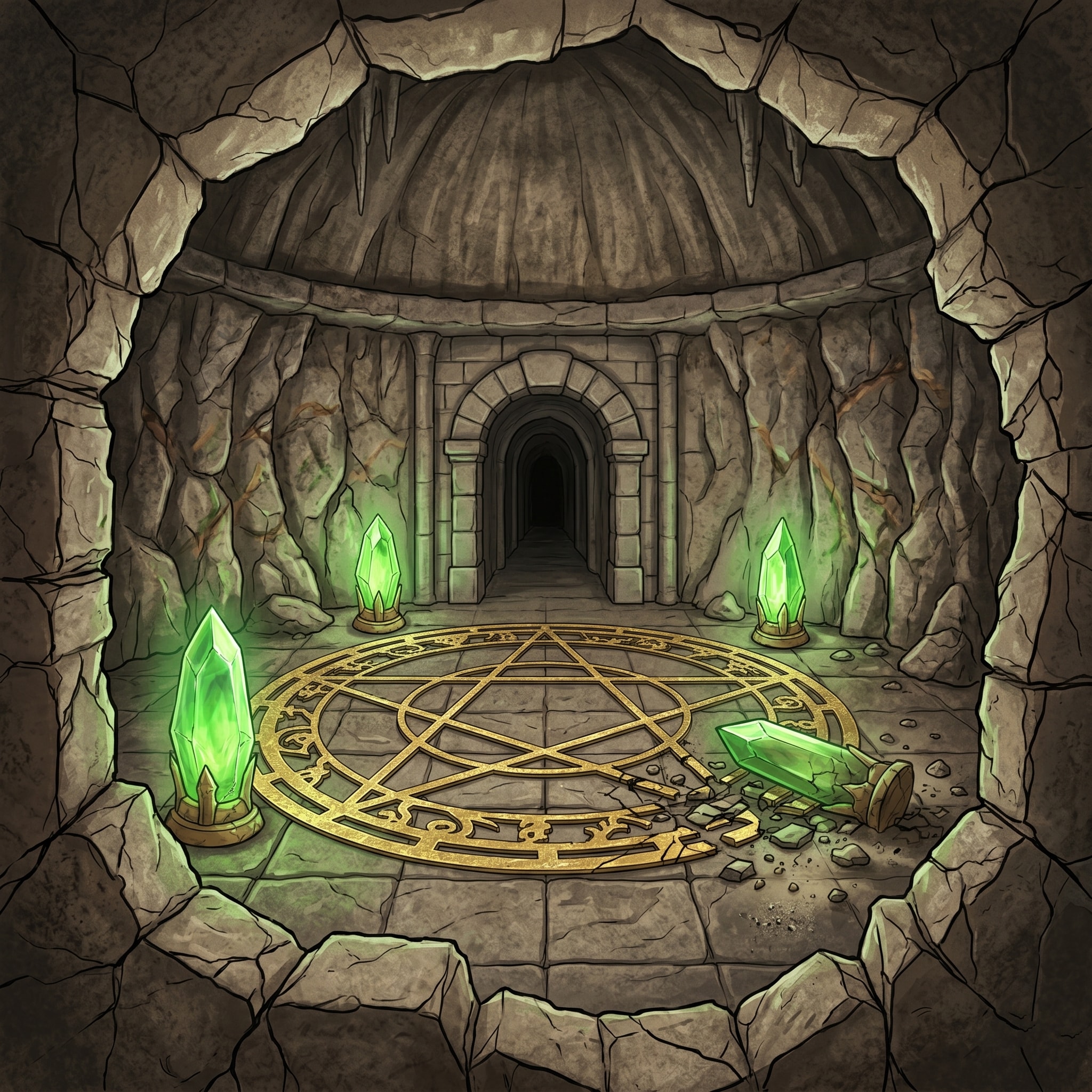
Kragor’s senses expanded. Illusion magic joined the others now— four schools detectable in the space, a catalog of purpose.
Therin spoke a word of divine will and sent a low tremor rippling through the stone floor, hoping the disturbance would shake loose anything alive. The fallen pillar jumped slightly, its crack lengthening.
Whisper moved in first, crossing the chamber with the economy of motion that characterized everything she did. She noted the smell—stale, organic, old. And from a doorway on the far side: a high, thin shrieking, like something imitating distress in a register just outside comfortable hearing.
Doctor Pepe crouched at the edge of the gold inscription and traced a section of it with his eyes. The script was unlike anything he recognized— dense, precise characters that none of the party could name. He twisted a ring on his finger, and something shifted behind his eyes. He pressed his palm flat against the floor, letting the spell settle, and began to read.
Scarlet examined the circle alongside him. The interpretation was not uncertain: this was a binding construction— designed to contain something, or to channel something, or both.
Kragor opened his mind wider. A thought, not quite a thought— a presence, more animal than verbal, registering from the left side of the chamber. He reached out telepathically to Elara, still in the tunnel— his thoughts arriving in her mind without sound: something was here, to the left, and the illusion magic he had sensed was coming from the same direction.
Elara stepped through into the chamber and called forth a wash of pale, cold light— violet-tinged, spreading across the left wall in a wide arc, the kind of light that clings to surfaces and creatures alike and strips away the refuge of shadow and invisibility. Nothing lit up. Whatever was along that wall had avoided the light— though how, none of them could say, since none of them could see it move.
The chamber held its breath. Kragor could still feel the presence— close, and closer—
The daemon appeared directly in front of him, mid-attack.
It was large and hulking, with the broad silhouette of a wolf standing upright— but the resemblance ended at the shape. Its mouth was enormous, split too wide across the face, packed with long, razored teeth that crowded each other for space. Its back had been torn open, or had never properly closed— raw muscle and glistening bone exposed to the air, the protruding bones jutting outward like ragged spikes still slicked with blood that did not dry.
Halite’s arm was already moving— the trident drawn back and released in one fluid motion before the daemon had finished materializing. It flew wide.
The daemon lunged into Kragor, its massive jaws finding flesh, and the bite carried something with it beyond pain— a shrieking intrusion into the warlock’s mind, a sound that had no business existing. Two sweeping claws followed. The second knocked Kragor flat.
From somewhere in the chamber, small, black-winged, and radiating outrage, a bat-like creature the size of a large cat screamed something in a harsh, guttural tongue. Doctor Pepe, whose ring had left the languages of the world briefly transparent to him, understood it perfectly. He informed the group that the creature was speaking Abyssal, and that it was saying: “Get the fat bastard! Hate him!”
The battle joined properly. Therin ran to Kragor, dropped to one knee beside the fallen warlock, and pressed a hand against his wounds. Healing energy flowed at the touch, knitting torn flesh back together. Whisper drew her whip and opened distance. Scarlet called something up from the stone floor— grasping vines and roots bursting through the rock as though the ground beneath the ancient chamber had been waiting for permission to grow. They wound around the daemon’s legs and held.
Kragor hauled himself upright and struck the restrained daemon, radiant energy crackling through the blow.
Elara loosed an arrow into the daemon, then broke into a few swift, deliberate movements— not quite a dance, not quite a gesture, but something between the two that hummed with fey energy. The music that accompanied it came from nowhere visible, felt more than heard. It washed over Doctor Pepe, Scarlet, and Halite, each of them suddenly buoyed by a warmth that sharpened their senses and lightened their limbs, the magic lending them a nimbleness and vigor that hadn’t been there a moment before.
Kragor, bleeding and freshly risen from the floor, remained trapped in immediate, perilous reach of the daemon’s claws. He was in desperate need of precisely that fey nimbleness to slip away safely, not to mention a measure of extra fortitude to weather whatever the beast decided to do next. Left conspicuously untouched by her magic, he looked around at his three newly invigorated companions, and then at Elara, with an expression that required absolutely no translation.
Doctor Pepe darted in with two quick strikes. Both missed—one generously, one inexplicably— and he withdrew to a more defensible position without visible distress.
Halite, meanwhile, recalled his trident to hand, planted his feet, and put it through the daemon. The blow landed clean. He took a moment afterward, drawing inward— finding that deep, stubborn reserve of stamina that fighters learn to call upon when tested. The lingering, ringing agony in his mind— the brutal psychic punishment dealt by the green flash when he breached the wall— eased back from the edge, allowing him to shake off the pain and refocus.
The daemon, furious but held fast by Scarlet’s vines, lashed out at the only target within reach. Its claws swept toward Kragor, but the grasping roots dragged at its limbs, spoiling the creature’s aim and sparing the warlock another trip to the stone floor.
The Ruby Golem
The walls vibrated. Then a large humanoid form entered the room from the far doorway. Standing perhaps seven feet, it seemed constructed entirely of a ruby-red crystal, catching and fracturing the ambient light into a scatter of crimson across the stone walls.
It went directly for the daemon.
Therin moved into the room, spread his fingers wide, and sent a roaring sheet of flame sweeping forward in a broad cone— it washed over the entangled daemon and caught the golem in the same breath. The bat-creature, hovering at the far doorway, watched Therin’s flames wash over the golem alongside the daemon and shrieked. Doctor Pepe translated: “Not him, you stupid fucking lizard!”
As the echo of the bat-creature’s shriek fading into the lingering heat of the cleric’s fire, the halfling druid was suddenly gone, and in her place a Moorbounder filled the room— all shoulder and fang and barely contained intention. The daemon, which had shown no emotion until this moment, took a half-step back. The bat-creature took one look at what Scarlet had become and disappeared into the far passage.
The Moorbounder leaped into the air over the daemon, and mid-air its claws shred its target’s back. Kragor pressed in and landed another blow. Elara tried to impose sleep on the creature— it shrugged the attempt off without blinking— and turned to Doctor Pepe instead, humming three rising notes directly at him— the kind that climb up the spine and arrive somewhere behind the sternum. Something in Doctor Pepe’s eyes sharpened. He was moving before the third note faded. His strike connected, and the daemon’s movements began to carry the particular heaviness of something running out of time.
Halite’s trident arced across the chamber and missed by a width that defied explanation.
Then the daemon tore free. The vines split and it launched itself across the chamber in a single bound— Kragor and the golem both swung as it left the ground, both cut air— and it came down in front of Elara.
The golem crashed after it and missed. Therin raised his holy symbol and poured a burst of searing divine light into the creature, the radiance of dawn forced into being in a lightless room beneath a mountain. The daemon reeled. Whisper slipped back into the chamber and opened a gash across its side. The Moorbounder drove in a heartbeat later, claws finding purchase in the ruin already made.
Bleeding and running out of time, Kragor made a brutal, calculated gamble. He struck another solid blow, then did something incredibly reckless: he called up a shell of killing cold that crept across his skin, freezing into jagged, glittering armor. Instead of slipping away to safety, the orc intentionally dropped his guard and backed away with agonizing slowness— offering himself as an irresistible target. The daemon took the bait. It lunged, its massive jaws clamping down on Kragor with a sickening crunch. The warlock’s vision grayed out as he was nearly torn in half, teetering on the very brink of death. But his trap was sprung. The icy armor detonated, sending razor-sharp shards blasting point-blank into the daemon’s face and throat, crippling the monster even as Kragor crumpled to the floor, barely clinging to life.
It was then that Doctor Pepe emerged from the shadows. Any trace of his earlier clumsiness had vanished. He moved with the terrifying, silent grace of a master assassin, assessing the staggering beast with a cold, unhurried eye. Stepping smoothly into the creature’s blind spot, the doctor slid his blade into the precise junction where the monster’s twisted anatomy knitted together. It was a strike of flawless, surgical finality— the quiet, deadly work of a professional.
The daemon dissolved, rapidly melting apart into a puddle of foul, dark sludge that splattered across the stone floor. The ruby golem lumbered over to the stain. It paused, staring down at the viscous puddle. Then, with the exaggerated, petty deliberation of the deeply disgruntled crushing a mildly irritating bug, the massive crystal construct lifted its heavy foot and violently, repeatedly stomped the completely inanimate ooze into the masonry.
The Writing Desk
With the daemon gone, attention shifted to the far doorway— the bat-creature had been seen flitting through it in the final moments of the fight, wings folding as it vanished into a room beyond the corridor. Any notion of a unified pursuit, however, was entirely absent. Scattered across the chamber by the brutal skirmish, bleeding, panting, and nursing various fresh grievances, the companions drifted toward the hallway in a disjointed trickle. Scarlet, deciding not to wait for the others to collect themselves, dropped into a rat’s form, darting ahead of their heavy boots down the passage and slipping into the chamber first.
The room beyond was a stagnant tomb of forgotten scholarship. Sagging bookcases lined the walls, standing shoulder-to-shoulder with shelves that groaned under the weight of tarnished, dust-caked arcane implements. At the heart of this quiet ruin sat a heavy wooden writing desk, occupied by a grim, motionless overseer.
The seated figure was little more than a husk. Its flesh had dried tight against the skull like ancient parchment, the hollowed cheeks and sunken features locked in an expression of eternal, rigid focus. Though clearly dead—or trapped in some state indistinguishable from death—the corpse’s unblinking eyes remained wide, staring at a small crystal vial resting on the wood of the desk with the terrible, unyielding gaze of a man who had stopped breathing long before he stopped watching.
From somewhere atop a shelf, the bat-creature screamed. Doctor Pepe translated the Abyssal: “Grab the amulet! It will kill the lizard!”
Out in the passage, the ruby golem proved the homunculus entirely correct. The towering construct pivoted toward Therin, a deep, angry crimson pulsing beneath its crystalline facets. The golem possessed a flawless memory for indignities, and it had not forgotten the cleric’s earlier indiscretion—the wave of roaring fire that had carelessly washed over it during the fight with the daemon. With terrifying speed, the golem closed the distance and brought a massive crystal fist crashing down, delivering a staggering, bone-rattling blow that communicated its accumulated grievance in the clearest possible terms.
Gasping for breath and clutching his bruised ribs, Therin wisely opted against a protracted debate. He scrambled backward, retreating into the dusty study and putting a careful distance between himself and the doorway, making sure to steer clear of the seated corpse. But as he caught his breath near the edge of the desk, his eyes fell upon a sudden glint in the gloom—a heavy ruby amulet draped directly against the withered collarbone of the dead wizard.
When Whisper slipped into the room a moment later, Therin pointed the jewelry out to her from his safe vantage point. Whisper approached the desk without ceremony, stripped the amulet from the dead man’s neck, and tossed it to Therin. Therin, exercising a healthy caution regarding dead wizards’ jewelry, flatly refused to catch it. The amulet clattered intact to the stone floor.
The bat-creature shrieked again, its tone conveying absolute disbelief. Doctor Pepe supplied the translation: “What the fuck is wrong with you!? Pick it up or it will kill you all!”
Before anyone else could act, Scarlet-rat scurried across the floor and snatched up the amulet.
“I can’t believe a rat is stealing the amulet!” the bat-creature wailed.
As Scarlet-rat hauled her prize up the side of the bookcase, the amulet’s cord slipped around her neck, bringing with it a sudden and overwhelming clarity. Her vision shifted, allowing her to see directly through the golem’s ruby form. Through the link, she could feel its internal state: a burning, singular rage directed entirely at Therin and his regrettable aim.
Scarlet dropped back to the floor and shifted fluidly into her halfling form. Imposing her will through the amulet, she commanded the construct to stand down.
The golem immediately went still.
As the rest of the party congregated into the room, Doctor Pepe offered a polite word of thanks to the bat-creature. Observing its reactions, the doctor ascertained that while the creature was entirely incapable of speaking Common, it understood the language perfectly well. It proved intelligent enough to be civil now that the daemon was gone and the amulet was in responsible hands. Prompted by the party, it attempted to explain— in its native, guttural Abyssal, which the doctor obligingly translated— how long its master had been looking at the vial. But here, the creature’s comprehension visibly fractured. It tried to quantify the wait, screeching about tens of thousands of sleeps, the slow crumbling of the stone, and a sheer, suffocating boredom that had outlasted memory. Lacking the arithmetic for centuries, its mind simply could not encompass the vast abyss of years that had passed. It could only convey a duration so staggering and incomprehensible that the mere effort of trying to describe it left the creature visibly exhausted.
Kragor, standing in the quiet aftermath of the violence, regarded the chittering creature. Knowledge drifted into his mind like cold flotsam from the dark depths of his patron’s awareness: the creature was a homunculus. This carried a fundamental implication— such artificial life is anchored to the vital force of its maker, dissolving into dust when the master perishes. Yet here the servant sat, fully corporeal and vibrating with annoyance. The desiccated figure in the chair was dead, certainly, but by some dark arithmetic, the creator still existed.
Doctor Pepe leaned closer to the desk, his eyes tracing the delicate crystal vial resting just inches from the corpse’s withered fingers. It was an object of exquisite craftsmanship, but it was marred. He pointed out a hairline fracture, barely thicker than a spider’s silk, running jaggedly down the length of the glass— a flaw that spoke of immense, sudden pressure.
Therin stepped up beside him, bringing a cleric’s sensitivity to the examination. He peered deeply into the clouded, fractured crystal. There, at the very center, suspended in a state of agonizing stasis, was the faintest trace of light. It was cold, contained, and utterly unmoving— a trapped spark refusing to go out, yet lacking the breath to truly burn. It was the object of the dead man’s endless, staring vigilance.
Letters from Margrethe
The party turned their attention first to the broader contents of the study, conducting a cautious search of the ancient shelves and the rows of arcane implements with the particular wariness of people who have recently been violently assaulted and prefer not to provoke any more of it. Finding little of immediate utility among the accumulated dust, they finally allowed their collective attention to settle on the writing desk and the withered figure maintaining its endless vigil.
A sorting of the desk’s clutter produced five letters, four open and one sealed. They were written in a fine, controlled hand and addressed to Kaspien— the name, presumably, of the desiccated figure still seated in the chair.
The correspondence outlined a desperate, illicit collaboration with a colleague named Margrethe in the city of Zemniaz. Concealing their deeply unethical research from the oversight of an institution known as the Forum, the two scholars had been secretly perfecting a perilous process for achieving magical immortality. The earlier letters charted Kaspien’s progress in constructing the laboratory around them, leading up to the eve of his own transition.
The story’s conclusion, however, lay in the fifth letter— the one with its seal unbroken.
It contained a frantic, last-minute warning. Margrethe had discovered a catastrophic flaw in their design: a volatile incompatibility between the chaotic magic required to cradle the soul and the highly structured residuum powering the chamber’s beacons. At the critical moment of soul-transfer, this resonance would spike, cracking the vessel from the inside out. Margrethe wrote that she had already survived her own transition and was waiting for him on the other side, providing the exact adjustments needed to prevent the fracture.
But the wax was unbroken. The warning had arrived too late.
The crystal vial sat on the desk. The crack ran along its length. The faint light inside it did not move.
Kragor looked at the homunculus. “Your master,” he said. The homunculus looked at the vial, then at Kragor, with the expression of a creature that has been waiting a very long time for someone to ask the right question.